

Description
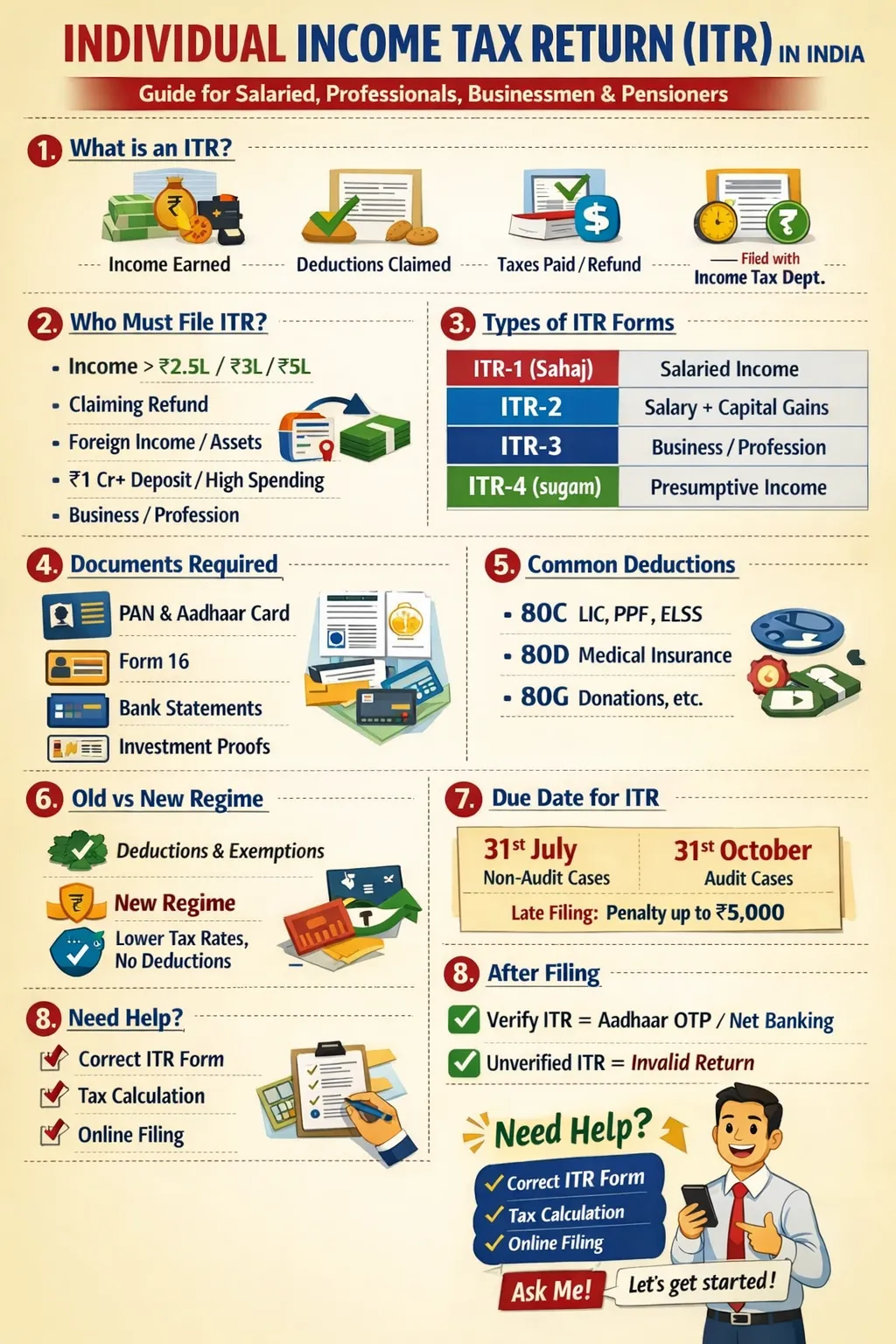
What is an Individual Income Tax Return (ITR)?
An ITR is a form through which an individual reports:
Income earned during the financial year
Deductions claimed
Taxes paid / refund claimed
It is filed with the Income Tax Department of India.
2️⃣ Who must file ITR? (Individual)
You must file ITR if:
Total income exceeds ₹2.5 lakh (₹3 lakh for senior citizens, ₹5 lakh for super senior)
You want to claim a refund
You have foreign income/assets
You deposited ₹1 crore+ in bank, spent high-value transactions
You are a businessman/professional
You want to carry forward losses
✅ Even if income is below limit, filing is recommended.
3️⃣ Types of ITR Forms for Individuals
ITR Form Who should use
ITR-1 (Sahaj) Salaried / pension income up to ₹50 lakh
ITR-2 Salary + capital gains (no business)
ITR-3 Business / professional income
ITR-4 (Sugam) Presumptive income (44AD / 44ADA / 44AE)
4️⃣ Documents Required
PAN Card
Aadhaar Card
Form 16 (for salaried)
Bank statements
Interest certificates
Investment proofs (80C, 80D, etc.)
Capital gain details (if any)
5️⃣ Deductions Commonly Claimed
80C – LIC, PPF, ELSS (₹1.5 lakh)
80D – Medical insurance
80CCD(1B) – NPS (₹50,000 extra)
80G – Donations
HRA / Home Loan Interest
6️⃣ Old Regime vs New Regime
Old Regime → Allows deductions & exemptions
New Regime → Lower tax rates, no deductions
📌 Default regime is New Tax Regime (from AY 2025-26 onwards).
7️⃣ Due Date for Individual ITR
31st July (Non-audit cases)
31st October (Audit cases)
Late filing → Penalty up to ₹5,000
8️⃣ After Filing – Important Step
✔️ ITR must be verified (Aadhaar OTP / net banking / EVC)
❌ Unverified ITR = Invalid return




Reviews
There are no reviews yet.